From the streamline "time of flight" that underpins commercial simulators to today's fast marching and machine-learning workflows.
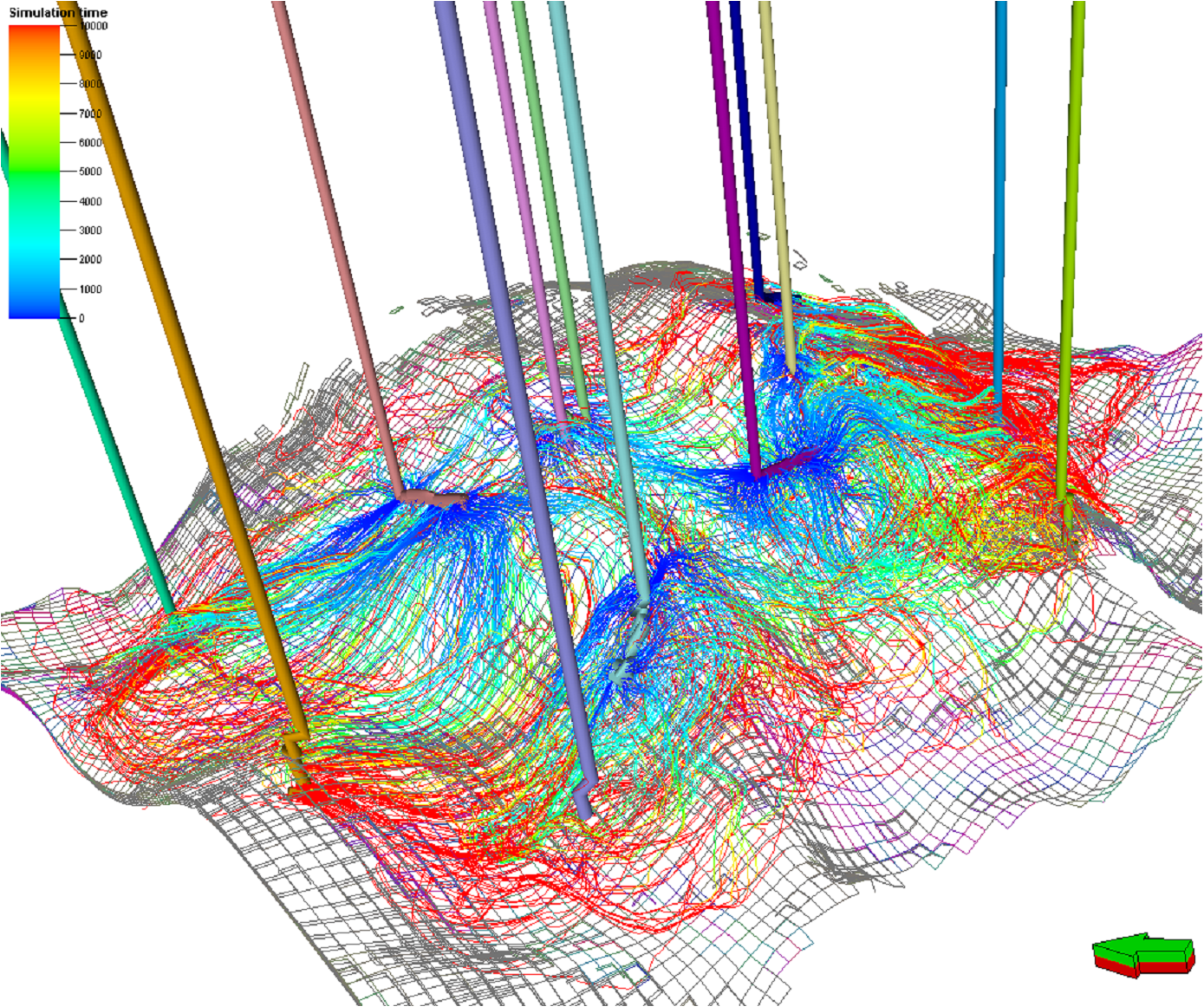
3-D streamline simulation is one of the major developments in reservoir simulation and forecasting. Several commercial simulators are built on the streamline "time of flight" concept introduced by Datta-Gupta and King in 1995.
As geologic models grew to multimillion cells, streamline simulation bridged the gap between geologic modeling, flow simulation and uncertainty assessment. Previous research work →
Instead of running a full simulation to find the depth of investigation, we solve directly for the pressure "front". A high-frequency asymptotic solution of the diffusivity equation gives the Eikonal equation, whose solution is the diffusive time of flight.

The front travels at the square root of diffusivity, independent of rate. Fast marching methods solve the equation in seconds, for heterogeneous media, anisotropic unstructured grids and multistage fractured horizontal wells.

Two decoupled steps: compute the diffusive time of flight with the fast marching method, then run fully implicit compositional simulation using it as the spatial coordinate. The 3-D problem becomes 1-D.
The result is orders-of-magnitude faster than full 3-D compositional simulation, with savings that grow with grid refinement, while keeping inter-porosity flow and nano-pore phase behavior.


Decline curve and rate transient analysis rest on simplifying assumptions and cannot describe the evolving drainage volume of a fractured well. Our model-free approach determines drainage volume and the instantaneous recovery ratio directly from production data.
A new w(τ) diagnostic plot reveals depletion mechanisms and fracture geometry, supporting fracture design, re-fracturing candidate selection and parameter estimation. This is the basis of the SPADES software.

Tight cluster spacing and large proppant volumes create fracture systems that are best represented on unstructured grids, where finite-volume simulation is costly.
We extend the fast marching approach from Cartesian and corner-point grids to unstructured grids: capture the drainage volume during pressure propagation, then solve flow in an equivalent 1-D domain.

Covariance-based transforms need a known covariance, are expensive for high-resolution models and do not preserve channels or other complex geology.
The grid-connectivity-based transform builds a model-independent basis from the grid itself, merging discrete Fourier analysis with spectral graph theory. Calibration is performed in the spectral domain with an adaptive multiscale workflow, on any grid geometry.

Calibration proceeds from global to local parameters and from coarse to fine scales. The "heavy hitters" among large-scale parameters are calibrated first with an evolutionary algorithm to match field-level energy.
Streamline-assisted multiscale inversion then matches well-by-well production history with local updates, refining the grid dynamically. The approach has been applied to many field cases with operating companies.

Dual porosity dual permeability systems need streamlines in both the fracture and matrix systems, and the two interact. We developed a robust tracing framework for these models using an embedded discrete fracture model.

Equalizing waterfront arrival times at all producers in a region delays breakthrough and reduces water cut. Streamlines give analytic sensitivities, gradient and Hessian, so the optimization scales to large fields with production and facility constraints.
Geological uncertainty is handled through a stochastic framework across realizations, and the method has been extended to polymer and CO2 flooding. This is the basis of SmartFlood.


Steady-state upscaling assumes pressure equilibrium inside a coarse block and cannot separate well-connected from weakly connected pay. Diffuse source upscaling builds basis functions from diffusive time of flight and drainage volume, and reconstructs transmissibility from pseudo-steady-state flow.
Below, the 7-million-cell Amellago carbonate model (courtesy of Dr. Sebastian Geiger, Heriot-Watt University) coarsened by a factor of six with the statistical layering algorithm in SWIFT-GEO.


Supported by the DOE SMART initiative and applied at the Illinois Basin-Decatur carbon storage project. Distributed temperature and pressure data are mapped to CO2 onset-time images with an autoencoder and regression network, enabling near real-time plume visualization and accelerated data assimilation.
Related work applies physics-informed machine learning to reservoir connectivity identification and CO2-EOR forecasting. See the publications.


