An industrial research consortium in the Harold Vance Department of Petroleum Engineering at Texas A&M University, co-directed by Dr. Akhil Datta-Gupta and Dr. Michael J. King.
Much of the mathematical foundation behind modern streamline simulation was developed in the consortium, and the co-directors co-authored the SPE textbook on the subject, Streamline Simulation: Theory and Practice.
Today MCERI remains one of the most active centers for streamline technology, multiscale data integration and history matching, upscaling and upgridding, performance analysis of unconventional wells, and science-informed machine learning for CO2 storage.
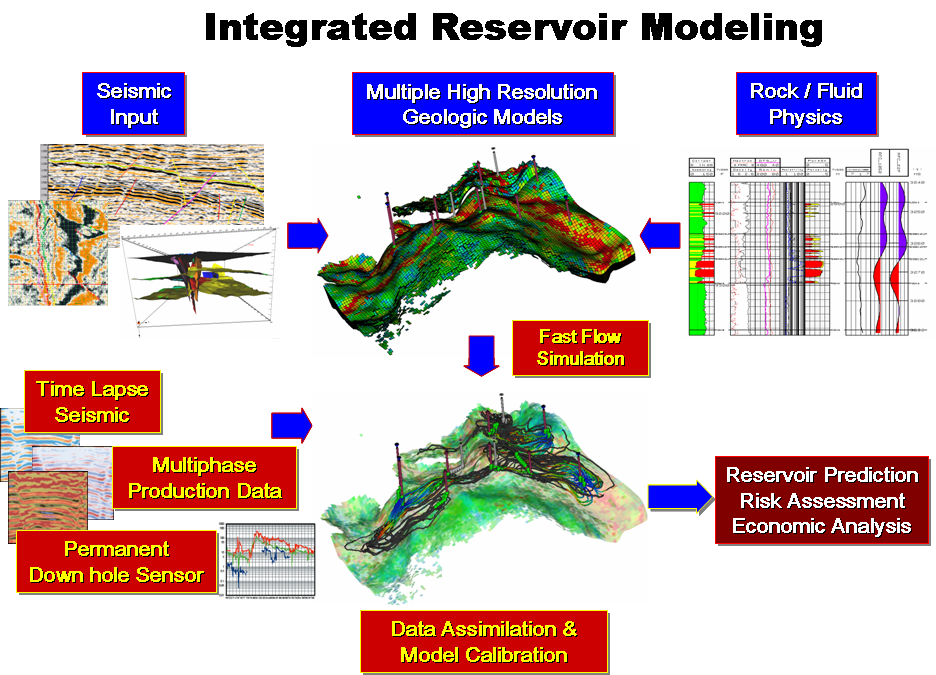
Reconciling high-resolution geologic models to pressure, tracer, production and time-lapse seismic data is the most time-consuming step in the workflow for geoscientists and engineers. Smart wells and permanent down-hole sensors make the data volume overwhelming.
MCERI develops the techniques and workflows to use that data efficiently: geologically consistent regionalization and re-parameterization, identification of reservoir property distributions, adaptive upgridding, and uncertainty quantification.
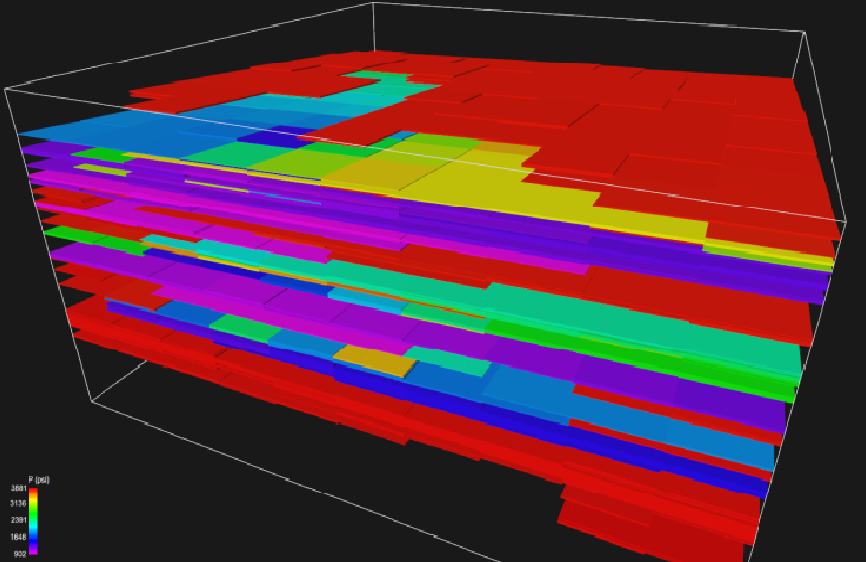
Using high-frequency asymptotic methods we generalized the depth of investigation to multistage hydraulically fractured wells through a diffusive time of flight, computed with fast marching methods.
Used as a spatial coordinate, it reduces the 3-D diffusivity equation to 1-D and gives a fast, comprehensive simulator for unconventional oil and gas reservoirs including multiphase and compositional effects. More about our research →

Results are presented to sponsors at the annual meeting, followed by a software training day. Sponsors receive the detailed annual report, semi-annual progress reports and source code for all software developed under the project.
We visit member companies to discuss research projects or train staff on the consortium software, with travel costs borne by the company.
Field application and validation with industrial partners is a major emphasis. Technology transfer happens through integration with in-house software or commercialization.

